
Food and Nutrition, Natural Disaster and Mitigation
DSWD says strict quality control for food packs
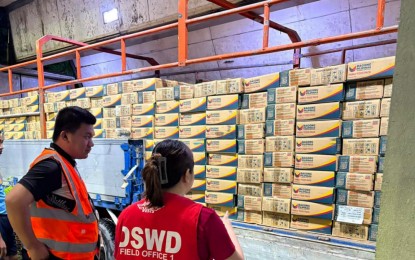
Department of Social Welfare and Development (DSWD) personnel supervise the unloading of family food packs (FFPs) in Bauang, La Union on Aug. 27, 2026. The DSWD on Wednesday (Sept. 2) said it enforces strict quality control measures to ensure the safety and quality of FFPs distributed to families affected by calamities. (Photo courtesy of DSWD)
The Department of Social Welfare and Development (DSWD) has reassured the public that all family food packs (FFPs) and other relief items distributed to disaster-affected families undergo rigorous multilevel quality control, safety inspections and nutritional evaluation prior to distribution.
Administrative Service (AS) Director Lawyer Karina Antonette Agudo, concurrently officer-in-charge (OIC) of the Procurement Management Division (PMD), said the DSWD’s procurement of relief goods strictly adheres to Republic Act (RA) 12009, or the New Government Procurement (NGP) Act.
The NGP Act mandates standardized legal processes in government procurement rather than simple off-the-shelf commercial purchasing.
“We subject every item to the procurement process, ensuring compliance with the law—specifically RA 12009, or the New Government Procurement Act. It is not merely an internal departmental procedure; rather, we adhere to the law and its established rules. We follow a specific set of processes, documentation and timelines that need to be followed. Bidders, too, have their own set of documents and requirements to submit; that is how the process works,” Agudo said.
According to Agudo, the procurement process begins with market scoping led by the Disaster Response and Management Group (DRMG) to establish precise technical specifications for each item, including the thickness of the can, volume, liquid content and structural rib requirements to ensure durability during handling.
“In our previous procurements—in past years—we tried the easy-open type, but during actual handling, it was more prone to bursting; naturally, they aren’t lifted individually but are stacked on pallets,” Agudo stressed.
To safeguard food quality, the DSWD enforces a three-level evaluation procedure comprising post-qualification by the Bids and Awards Committee (BAC) and Technical Working Group (TWG), pre-delivery inspection involving actual cooking and taste testing, and random post-delivery physical inspections at storage facilities.
To verify taste, smell, color and texture, the DSWD said suppliers are required to present a hedonic sensory test certification from the Department of Science and Technology (DOST) before any goods are accepted.
To maintain quality upon release, expiration periods are calculated strictly upon actual warehouse delivery.
In line with the DSWD’s zero-wastage policy, food packs reaching three months before expiry are immediately reallocated under the food-for-work modality of community programs such as Project LAWA (Local Adaptation to Water Access), BINHI (Breaking Insufficiency, Nurturing Hope Initiatives), residential care centers or Crisis Intervention Unit (CIU) clients.
The DSWD assures the public that measures are in place to provide efficient service, especially to those affected by disasters. This is in line with the directive of the President to ensure that the needs of families in distress due to calamities are addressed.
Moreover, officials reiterated to the public that they should report to the DSWD any untoward incidents related to the FFPs so that the Department can conduct the necessary investigation and take appropriate action.
Help this knowledge grow
Have additional information, a correction, or a supporting resource for this article?
Try the form and preview your contribution. Nothing is submitted or saved. Closing the form or leaving this page clears your draft.